
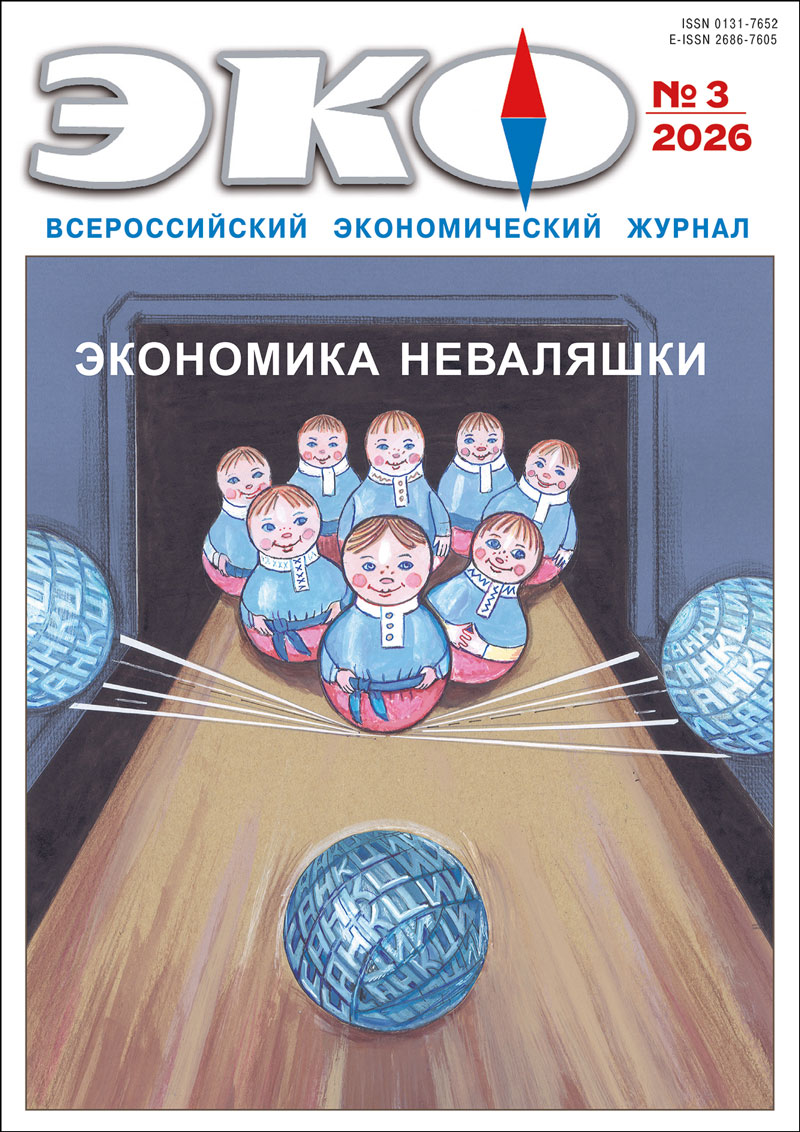
Cover story: Tumbler Economy
What do Russian Enterprises Need under Strengthened Sanctions?
Published 2026-05-21
Keywords
- manufacturing enterprises; sanctions; state support; business environment; needs of enterprises; adaptation strategies
How to Cite
1.
Ershova Н, Rodionov Ю, Balaeva О. What do Russian Enterprises Need under Strengthened Sanctions?. ECO [Internet]. 2026 May 21 [cited 2026 Jul. 30];56(3):28-49. Available from: https://ecotrends.ru/index.php/eco/article/view/4966
Abstract
The Russian government has implemented a wide range of anti-crisis measures to support manufacturing industries in response to the large-scale external challenges of recent years, including the consequences of the COVID-19 pandemic and the strengthening of the international economic sanctions in 2022. However, the expectations and demands of enterprises were poorly considered when developing these measures. This study is based on unique data collected in the second half of 2022 and includes an open-ended question on the needs and requests of industrial enterprises. Our results showed that the negative assessment of the impact of sanctions on the enterprise’s activities, high assessment of the probability of bankruptcy, investment activity, the availability of financial/organizational state support and the age of the enterprise significantly affect the type of expectations from enterprises. It underlines the importance of flexible adjustment of economic policy based on the real needs and priorities of the enterprises themselves.References
- Дранев С.Я. Изменение институциональных условий развития российской промышленности в 2022–2024 гг. / Научные труды: Институт народнохозяйственного прогнозирования РАН. 2024. № 2. C. 71–94. https://doi.org/10.47711/2076–3182–2024–2–71–94
- Кузнецов Б.В., Голикова В.В. Руководители обрабатывающих предприятий России о санкционных ограничениях и уязвимости к ним // ЭКО. 2023. Т. 53, № 9. С. 33–51. https://doi.org/10.30680/ECO0131–7652–2023–9–33–51
- Кузык М.Г., Симачев Ю.В. Стратегии адаптации российских компаний к санкциям 2022 г // Журнал Новой экономической ассоциации. 2023. Т. 3. № 60. С. 172–180. https://doi.org/10.31737/22212264_2023_3_172–180
- Симачев Ю.В., Федюнина А.А., Кузык М.Г., Юревич М.А., Городный Н.А., Ширшиков А.О. Мир в лабиринте санкций: промышленная политика на перепутье. М.: Издательский дом НИУ ВШЭ, 2024. 163 с. URL: https://indpolicy.hse.ru/mirror/pubs/share/918374473.pdf (дата обращения: 19.07.2025).
- Симачев Ю.В., Яковлев А.А., Голикова В.В., Городный Н.А., Кузнецов Б.В., Кузык М.Г. Федюнина А.А. Адаптация российских промышленных компаний к санкциям: первые шаги и ожидания, М.: Издательский дом НИУ ВШЭ, 2023. 40 с. URL: https://publications.hse.ru/books/856403782 (дата обращения: 19.07.2025).
- Яковлев А.А., Балаева О.Н., Родионова Ю.Д., Ткаченко А.В. Проблемы и эффективность госзакупок глазами их участников // ЭКО. 2020. № 11 (557). С. 83–103. https://doi.org/10.30680/ЕСО0131–7652–2020–11–83–103
- Яковлев А.А., Ершова Н В., Уварова О.М. Каким фирмам государство оказывает поддержку: анализ изменения приоритетов в кризисных условиях // Вопросы экономики. 2020. № 3. С. 47–62. https://doi.org/10.32609/0042–8736–2020–3–47–62
- Яковлев А.А., Фрейнкман Л.М., Ершова Н.В., Агалян А.А. Оценка эффективности инструментов промышленной политики в России: новые подходы // ЭКО. 2023. № 53. С. 60–83. https://doi.org/10.30680/ECO0131–7652–2023–2–60–83
- Gaur, A., Settles, A., Väätänen, J. (2023). Do Economic Sanctions Work? Evidence from the Russia-Ukraine Conflict. Journal of Management Studies. Vol. 60. Pp. 1391–1414. https://doi.org/10.1111/joms.12933
- Golikova, V.V. (2023). The impact of economic sanctions on firm performance: Perceptions of Russian SME managers. Russian Management Journal. Vol. 21. No. 4. Pp. 552–578. https://doi.org/10.21638/spbu18.2023.405
- Golikova, V., Kuznetsov, B. (2017). Perception of risks associated with economic sanctions: the case of Russian manufacturing. Post-Soviet Affairs/. Vol. 33. No. 1. Pp. 49–62. https://doi.org/10.1080/1060586X.2016.1195094
- Gorodnyi, N., Fedyunina, A., Simachev, Y. (2025). The Role of Pricing and Export Diversification in Global Value Chains Resilience: Evidence from Russian Manufacturing Firms under Dual Shocks. Russian Journal of Economics. Vol. 11. No. 1. Pp. 27–46. https://doi.org/10.32609/j.ruje.11.144072
- Kuvalin, D.B, Zinchenko, Y.V, Lavrinenko, P.A, Ibragimov S.S. (2022). Russian Enterprises in the Spring of 2022: Adapting to the New Wave of Sanctions and Views on the ESG Agenda. Studies on Russian Economic Development. Vol. 33. No. 6. Pp. 697–706. https://doi.org/10.1134/S1075700722060089
- Kuvalin, D.B, Zinchenko, Y.V, Lavrinenko, P.A, Ibragimov, S.S. (2023b). Russian Enterprises at the End of 2022: Countering Sanctions, Relations with Banks and Reaction to the Climate Agenda. Studies on Russian Economic Development. Vol. 34. No. 3. Pp. 419–432. https://doi.org/10.1134/S1075700723030073
- Kuvalin, D.B., Zinchenko, Y.V., Lavrinenko, P.A., Ibragimov S.S., Zaytseva A.A. (2023a). Russian Enterprises in the Spring of 2023: Overcoming the Sanctions Crisis and Strengthening Investment Activity. Studies on Russian Economic Development. Vol. 35. Pp. 150–160. https://doi.org/10.1134/S1075700724010076
- Miromanova, A. (2023). Quantifying the trade-reducing effect of embargoes: Firm level evidence from Russia. Canadian Journal of Economics. Vol. 56. No. 3. Pp. 1121–1160. https://doi.org/10.1111/caje.12667
- Vlasova, V., Boiko, K., Kuznetsova, T. (2024). Overcoming Internal and External Barriers for the Innovative Development of Businesses. Foresight and STI Governance. Vol. 18. No. 2. Pp. 85–96. https://doi.org/10.17323/2500–2597.2024.2.85.96