
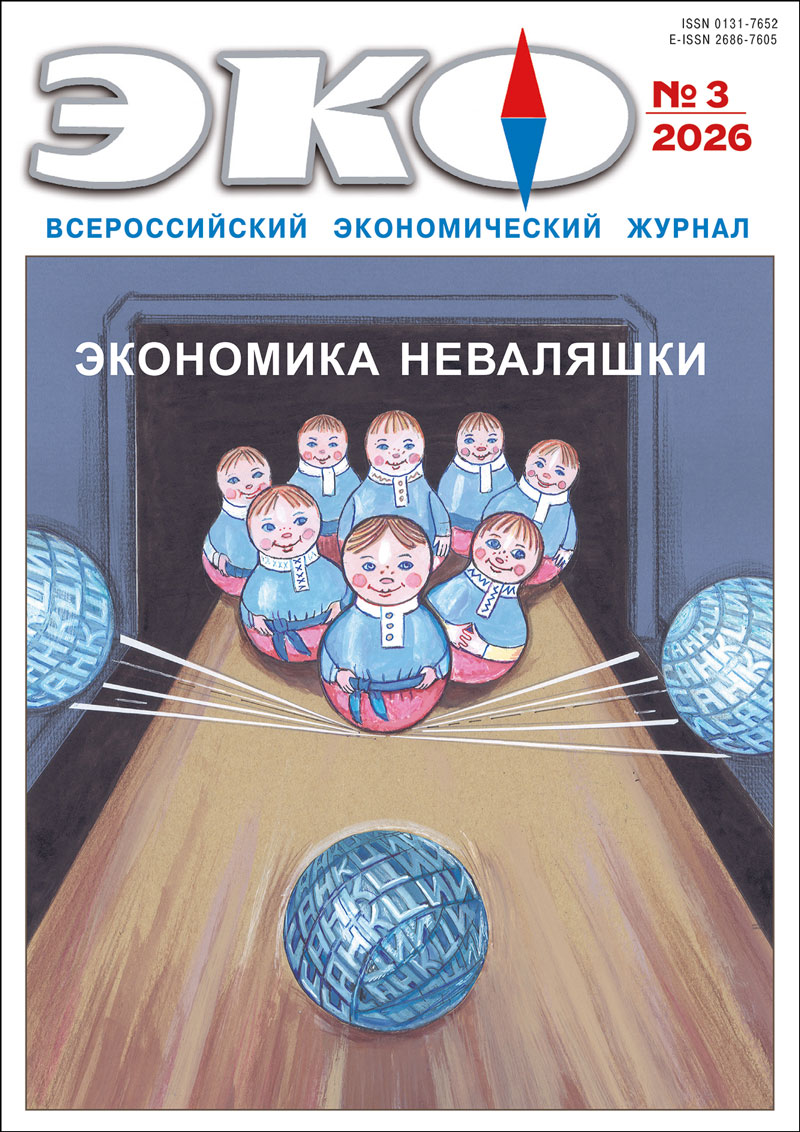
Cover story: Tumbler Economy
Adapting to Tightening Western Sanctions by Cutting Capital Outflows, Foreign Trips and Car Imports
Published 2026-05-21
Keywords
- balance of payments; ruble exchange rate; currency control; legalization; counteracting legalization; tax control; progressive taxation; business fragmentation
How to Cite
1.
Anureev С. Adapting to Tightening Western Sanctions by Cutting Capital Outflows, Foreign Trips and Car Imports. ECO [Internet]. 2026 May 21 [cited 2026 Oct. 26];56(3):65-87. Available from: https://ecotrends.ru/index.php/eco/article/view/4968
Abstract
Russia has faced a serious decline in oil prices and export volumes, and the goal of this article is to analyze historical experience of adaptation to such shocks. Statistic, econometric and stress-test analysis are conducted for export revenue of oil, capital outflows, payments for car import of foreign tourism over 20 years. The authors’ stress test assumptions are $56 per barrel and a 10% reduction in export volumes from the 2024 level. The results of the authors’ analysis show that, a hypothetical reduction in exports by $63 billion for oil and gas and by $44 billion for other commodities (almost to the level of the 2020 Covid year) could be offset by a reduction in capital outflow by $56 billion and imports for the rich by $51 billion (to the 2004 level, adjusted for inflation). The author’s study presents specific quantitative characteristics of the currency and tax control measures in crisis periods.References
- Буздалина О.Б. Методы государственного финансового регулирования в условиях вводимых экономических санкций // Аудиторские ведомости. 2022. № 2. С. 36–40.
- Викулов С.Ф., Горгола Е.В., Гладышевский В.Л. Военно-экономическое противоборство России и Запада в специальной военной операции по демилитаризации/денацификации Украины // Национальные интересы: приоритеты и безопасность. 2023. Т. 19, № 11. С. 2006–2026.
- Глинская М.В. Полежаев М.А. Влияние западных санкций на динамику экономического развития: опыт Ирана для Российской Федерации // Россия и Азия. 2024. № 1 (27). С. 16–30.
- Гэлбрейт Д.К. Подарок санкций: анализ оценок российской экономики, 2022–2023 гг. // ЭКО. 2023. № 9 (591). С. 8–32. DOI: 10.30680/ECO0131–7652–2023–9–8–32
- Зотиков Н.З. Нефтегазовые доходы федерального бюджета в условиях западных санкций // Вестник Сургутского государственного университета. 2022. № 4 (38). С. 27–35. DOI: 10.34822/2312–3419–2022–4–27–35
- Магадиев М.Ф. Зависимость современной российской элиты от социально-экономических санкций ведущих западных стран как угроза национальной безопасности Российской Федерации // Вопросы политологии. 2022. Т. 12. № 6 (82). С. 1945–1953.
- Макашина О.В. Анализ отечественного опыта формирования финансовой политики в постковидной экономике с учетом нарастания санкционного давления // Финансовая жизнь. 2023. № 4. С. 4–8.
- Понкратов, В.В., Караев, А.К. Влияние экономических санкций и пандемии коронавирусной инфекции на эффективность валютного рынка России // Менеджмент и бизнес-администрирование. 2022. № 3. С. 125–132.
- Смирнов В.В. Основа финансового суверенитета России // Национальные интересы: приоритеты и безопасность. 2024. Т. 20, № 5. С. 822–841.
- Стрижак А.Ю., Дмитриченко Л.И., Дадашова Т.А. Региональный аспект потребления доступной роскоши в условиях санкций (на примере iPhone) // Экономические и социально-гуманитарные исследования. 2023. № 4 (40). С. 123–130. https://doi.org/10.24151/2409–1073–2023–4–123–130 EDN: NHPGLY
- Хлопов О.А. Энергетическая независимость США: возможности реализации и ограничения // США и Канада: экономика, политика, культура. 2024. № 3 (651). С. 15–28.
- Юсупов П.Т. Трансформация мирового рынка нефти под влиянием западных санкций // Инновации и инвестиции. 2023. № 6. С. 57–61.
- Ashford, E. (2016). Not-So-Smart Sanctions: The Failure of Western Restrictions Against Russia. Foreign Affairs. No. 95(1). Pp. 114–123. http://www.jstor.org/stable/43946631
- Barseghyan, Gayane. (2019). Sanctions and counter-sanctions: What did they do? Bank of Finland, Institute for Economies in Transition (BOFIT), Helsinki. BOFIT Discussion Papers, No. 24. ISBN978–952–323–306–5 https://www.econstor.eu/bitstream/10419/212932/1/bofit-dp2019–024.pdf
- Davis, J.S., Fujiwara, I., Kevin, X.D., Huang and Jiao Wang. (2022). Russia counters sanctions’ impact with currency controls, averts crisis (for now). Dallas Fed Economics. May 31.
- Fokin, N.D., Malikova, E.V, Polbin, A.V. (2024).Time-varying parameters error correction model for real ruble exchange rate and oil prices: What has changed due to capital control and sanctions? Russian Journal of Economics. No. 10(1).
- Gould-Davies, Nigel. (2018). Economic effects and political impacts: Assessing Western sanctions on Russia, BOFIT Policy Brief. No. 8. Bank of Finland, Institute for Economies in Transition (BOFIT), Helsinki, https://nbn-resolving.de/urn: nbn: fi: bof-201808091970
- Gurvich, E, Prilepskiy, I. (2015).The impact of financial sanctions on the Russian economy. Russian Journal of Economics. Vol. 1. Iss. 4. December. Pp. 359–385. DOI:10.32609/0042–8736–2016–1–5–35
- Zhentao, Li, Tianzi, Li. (2022). Economic Sanctions and Regional Differences: Evidence from Sanctions on Russia. Sustainability 14(10), 6112; https://doi.org/10.3390/su14106112
- Мamonov, M., Pestova, A. (2023).The Price of War: Macroeconomic and Cross-Sectional Effects of Sanctions on Russia. CERGE-EI Prague, June Working Paper Series (ISSN2788–0443).