
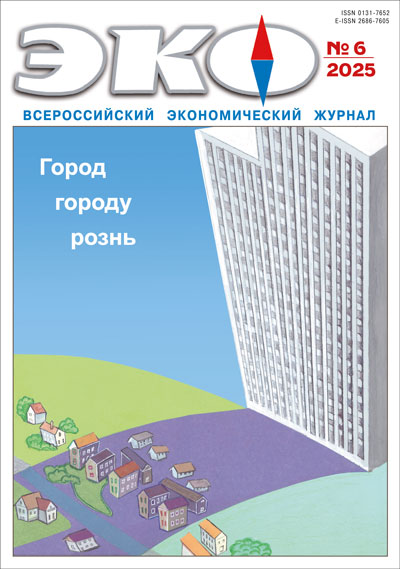
Cover story: Every Сity is Different
Comprehensive Ecological and Economic Assessment of Water Consumption in the Constituent Entities of the Russian Federation
Published 2025-11-30
Keywords
- regional economy; sustainable development; water resources; water potential; water ranking; water intensity of the economy; ecological intensity
How to Cite
1.
Tretyakova Е, Gottfried А. Comprehensive Ecological and Economic Assessment of Water Consumption in the Constituent Entities of the Russian Federation. ECO [Internet]. 2025 Nov. 30 [cited 2026 Oct. 13];55(6):82-99. Available from: https://ecotrends.ru/index.php/eco/article/view/4917
Abstract
Rationalization of water resource usage and protection of water bodies are global priorities today. They require a systematic approach to the solution. However, researchers do not have multi-criteria assessment systems. As a result, decision makers do not have all the information. This paper presents a system of indicators developed by the authors, which to some extent compensates for this gap. It allows us to assess 1) regional water potential, 2) water quality, 3) the water intensity of the economy, 4) the extent of water pollution, and 5) water management. It allows us to build a water ranking of the regions of the Russian Federation, identify common and specific problems and the most relevant areas of management impact in order to improve the efficiency of water resources use.References
- Власов М.В., Куприянова С.В. Эколого-экономическое обоснование эффективности охраны водных ресурсов на основе рециклинга дренажно-сбросных вод // Экология и водное хозяйство. 2022. Т. 4. № 4. С. 43–55. DOI 10.31774/2658–7890–2022–4–4–43–55
- Дружинин П.В., Шкиперова Г.Т. Прогнозирование ограничений экономического роста северных регионов на основе оценки «окон устойчивости» // Арктика и Север. 2021. № 44. С. 45–63.
- Забелина И.А. Оценка социо-эколого-экономического благополучия регионов востока России с использованием расширенной функции А. Сена // Экономика региона. 2022. Т. 18, вып. 2. С. 398–412. https://doi.org/10.17059/ekon.reg.2022–2–7
- Забелина И.А. Россия и Китай: экологический и ресурсный эффекты декаплинга // ЭКО. 2023. № 3. С. 68–92. DOI: 10.30680/ECO0131–7652–2023–3–68–92
- Косолапова Н.А., Матвеева Л.Г. Сценарный подход к оптимизации использования водных ресурсов в регионе // Естественно-гуманитарные исследования. 2022. № 42(4). С. 141–148.
- Макаров И.А., Чернокульский А.В. Влияние изменения климата на экономику России: рейтинг регионов по необходимости адаптации // Журнал новой экономической ассоциации. 2023. № 4 (61). С. 145–202. DOI: 10.31737/22212264_2023_4_145–202
- Рюмина Е.В. Экологические аспекты оценки качества жизни // Экономика региона. 2016. Т. 12, № 4. С. 1113–1122. DOI: doi.org/10.17059/2016–4–13
- Третьякова Е.А. Экологическая интенсивность экономического развития регионов Северо-Запада // Балтийский регион. 2019. Т. 11, № 1. С. 14–28. DOI 10.5922/2079–8555–2019–1–2
- Турсуналиева Д.М., Токтосунова Ч.Т. Основные проблемы использования водных ресурсов и охраны водных объектов в Кыргызской Республике // Вестник Иссык-Кульского университета. 2022. № 51. С. 91–98.
- Фомина В.Ф. Оценка водопользования северных регионов России по критериям устойчивого развития // Север и рынок: формирование экономического порядка. 2023. Т. 26. № 4(82). С. 157–174. DOI: 10.37614/2220–802X.4.2023.82.011
- Щедрин В.Н., Масный Р.С., Манжина С.А., Куприянова С.В. Стратегический подход к развитию мелиорации в условиях меняющегося климата // Мелиорация и водное хозяйство. 2022. № 2. С. 11–17. DOI 10.32962/0235–2524–2022–2–11–18
- Huang, Z., Nya, E.L., Rahman, M.A., Mwamila, T.B., Cao, V., Gwenzi, W., Noubactep, C. (2021). Integrated Water Resource Management: Rethinking the Contribution of Rainwater Harvesting. Sustainability. Vol. 13. DOI: https://doi.org/10.3390/su13158338
- Lee, U., Chou, J., Xu, H. (2020). Regional and seasonal water stress analysis of United States thermoelectricity. Journal of Cleaner Production. Vol. 270. DOI: 10.1016/j.jclepro.2020.122234
- Li, D., Zuo, Q., Zhang, Z. (2022). A new assessment method of sustainable water resources utilization considering fairness-efficiency-security: A case study of 31 provinces and cities in China. Sustainable Cities and Society. Vol. 81. P. 103839. DOI: https://doi.org/10.1016/j.scs.2022.103839
- Luukkanen, J., Kaivo-oj, a J., Vahakar, N., O’Mahony, T., Korkeakoski, M., Panula-Ontto, J., Vehmas, J., Nguyen, Q.A. (2018). Resource efficiency and green economic sustainability transition evaluation of green growth productivity gap and governance challenges in Cambodia. Sustainable Development. Vol. 27(3). Pp. 1–9. DOI: 10.1002/sd.1902
- Nagata, K., Shoji, I., Arima, T., Otsuka, T., Kato, K., Matsubayashi, M., Omura, M. (2021). Practicality of integrated water resources management (IWRM) in different contexts. International Journal of Water Resources Development. Vol. 1(23). DOI: 10.1080/07900627.2021.1921709
- Ritchie, H., Roser, M. (2017). Water use and stress. Our World in Data. Available at: DOI: https://ourworldindata.org/water-use-stress
- Sachs, J.D., Lafortune, G., Fuller, G., Drumm, E. (2023). Implementing the SDG Stimulus. Sustainable Development Report. Dublin: Dublin University Press. DOI: 10.25546/102924
- Uddin, M.G., Nash, S., Rahman, A., Olbert, A. I. (2023). A sophisticated model for rating water quality. Science of the Total Environment. Vol. 868. DOI: https://doi.org/10.1016/j.scitotenv.2023.161614