
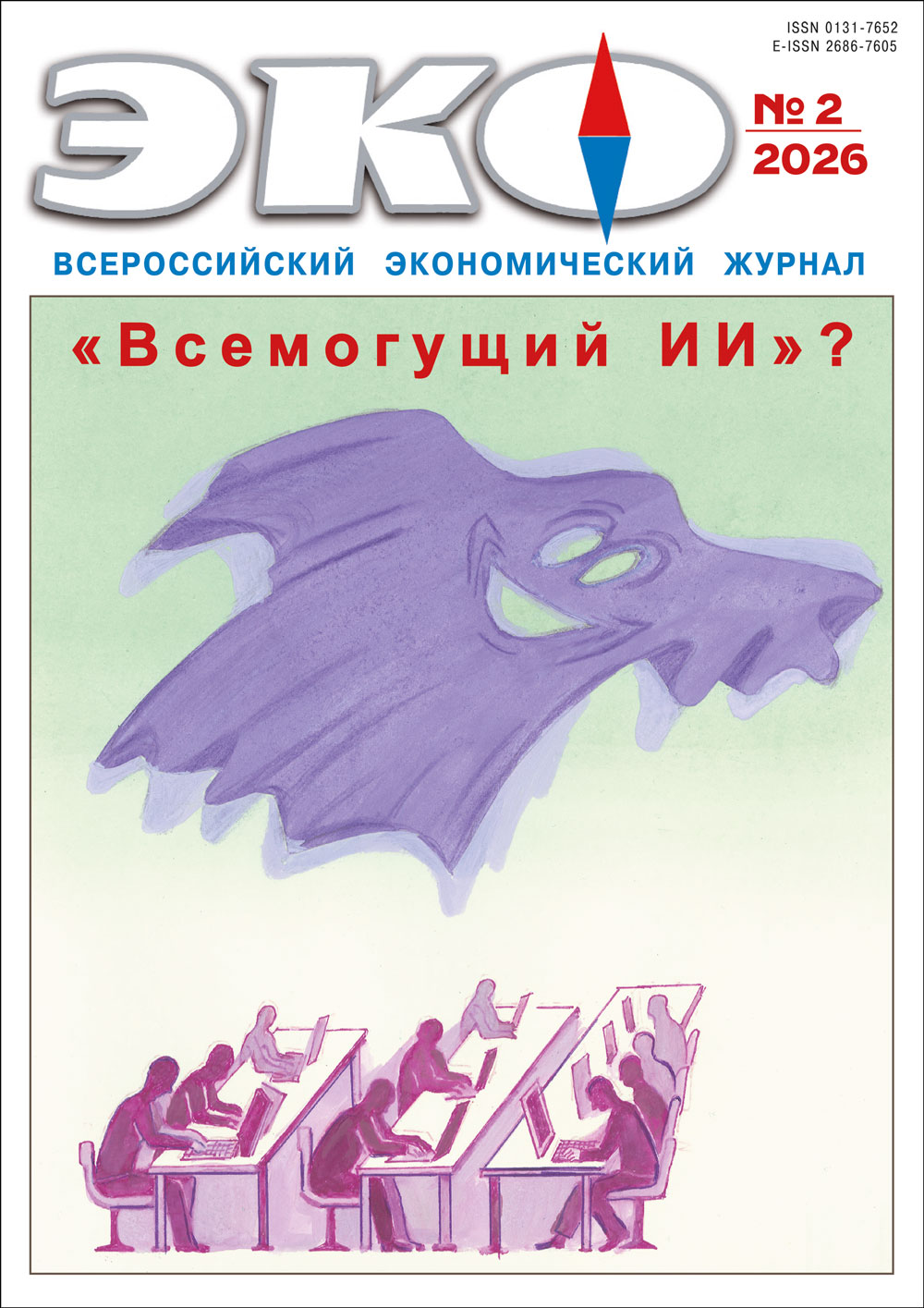
Тема номера: "Всемогущий ИИ"?
Дилемма индустрии искусственного интеллекта: между технологическим прорывом и угрозами стабильности
Опубликован 06.04.2026
Ключевые слова
- искусственный интеллект; риски; регулирование ИИ; экономические и социальные последствия ИИ; системные угрозы; кибербезопасность
Как цитировать
1.
Матраева Л, Васютина Е. Дилемма индустрии искусственного интеллекта: между технологическим прорывом и угрозами стабильности. ECO [Интернет]. 6 апрель 2026 г. [цитируется по 14 октябрь 2026 г.];56(2):7-25. доступно на: https://ecotrends.ru/index.php/eco/article/view/4951
Аннотация
Статья посвящена анализу и систематизации рисков, сопровождающих развитие индустрии искусственного интеллекта (ИИ). На основе теоретических положений технологического развития и концепций цифрового регулирования выявлены четыре ключевые группы рисков, влияющие на устойчивость макроэкономических и социальных систем: трансформация рынка труда, системные искажения эффективности, угрозы достоверности данных и скрытые социальные последствия. Представлено авторское видение модели ответственного ИИ, которая может служить основой для разработки нормативно-правовой базы и механизмов надзора за использованием ИИ-технологий с целью минимизации этих рисков.Библиографические ссылки
- Кочергин С.В., Артемова С.В., Бакаев А.А., Митяков Е.С., Вегера Ж.Г., Максимова Е.А. Кибербезопасность смарт-сетей: сравнение подходов машинного обучения для обнаружения аномалий // Russian Technological Journal. 2024. № 12(6). С. 7–19. DOI: 10.32362/2500–316X-2024–12–6–7–19
- Пашенцев Е.Н. Искусственный интеллект: новые угрозы для международной информационно-психологической безопасности и пути их нейтрализации // Новая эпоха международной безопасности. Россия и мир: Монография / Отв. pед. О.П. Иванов. М.: Общество с ограниченной ответственностью «Проспект», 2023. С. 64–95.
- Шваб К. Четвертая промышленная революция. М.: Эксмо, 2016. 138 с.
- Acemoglu, D., Restrepo, P. (2019). Automation and new tasks: How technology displaces and reinstates labor. Journal of Economic Perspectives 33. No. 2. Pp. 3–30. DOI: 10.1257/jep.33.2.3
- Acemoglu, D. (2010). When Does Labor Scarcity Encourage Innovation? // Journal of Political Economy. Vol. 118, No. 6. Pp. 1037–1078.
- Brundage, M., et al. (2018). The Malicious Use of Artificial Intelligence: Forecasting, Prevention, and Mitigation. arXiv. arXiv:1802.07228. DOI: 10.48550/arXiv.1802.07228
- Brynjolfsson, E., Unger, G. (2023). The macroeconomics of artificial intelligence. Finance and development magazine. DECEMBER. Pp. 20–25. https://www.imf.org/en/Publications/fandd/issues/2023/12/Macroeconomics-of-artificial-intelligence-Brynjolfsson-Unger
- Carlini, N. et al. (2024). Poisoning Web-Scale Training Datasets is Practical, in 2024 IEEE Symposium on Security and Privacy (SP), San Francisco, CA, USA. Pp. 407–425. DOI: 10.1109/SP54263.2024.00179
- Collingridge, D. (1980). The social control of technology. London: Frances Pinter. 200 p.
- Frey, C.B. & Osborne, M.A. (2013). The Future of Employment: How Susceptible Are Jobs to Computerisation? Technological Forecasting and Social Change. T.114. DOI: 10.1016/j.techfore.2016.08.019
- Giannini, S. (2024). Generation AI: Navigating the opportunities and risks of artificial intelligence in education. UNESCO. 22 July. Available at: https://www.unesco.org/en/articles/generation-ai-navigating-opportunities-and-risks-artificial-intelligence-education (accessed: 02.03.2026).
- Hatzius, J., Briggs, J., Kodnani, D., Pierdomenico, G. (2023). The Potentially Large Effects of Artificial Intelligence on Economic Growth. Goldman Sachs Global Investment Research. 26 March. Available at: https://www.gspublishing.com/content/research/en/reports/2023/03/27/d64e052b-0f6e-45d7–967b-d7be35fabd16.html
- Hayami, Y., Ruttan, V.W. (1971). Induced Innovation and Agricultural Development, Staff Papers 13967, University of Minnesota, Department of Applied, DOI: 10.22004/ag.econ.13967
- Jonas, Hans (1984). The imperative of responsibility: in search of an ethics for the technological age. Chicago: University of Chicago Press. P. 202.
- Li, P., Yang, J., Islam, M.A., & Ren, S. (2023). Making AI Less "Thirsty": Uncovering and Addressing the Secret Water Footprint of AI Models. ArXiv, abs/2304.03271
- Loewen, P., Lee-Whiting, B., Arai, M., Bergeron, T., Galipeau, T., Gazendam, I., Needham, H., Slinger, L., Yusypovych, S. (2024). Global public opinion on artificial intelligence (GPO-AI). Schwartz Reisman Institute for Technology and Society. 109 p. Available at: https://srinstitute.utoronto.ca/public-opinion-ai
- Mandel, D.R. (2023). Artificial General Intelligence, Existential Risk, and Human Risk Perception. arXiv. https://arxiv.org/abs/2311.08698
- Matraeva, L. et al. (2020). The effects of digitalisation on the labour market: The case of Russia / L. Matraeva, E. Vasiutina, A. Belyak. Work Organisation, Labour and Globalisation. Vol. 14, No. 2. Pp. 31–45. DOI 10.13169/WORKORGALABOGLOB.14.2.0031. EDN IGOASI
- Morales, J. (2024). Research shows more than 80% of AI projects fail, wasting billions of dollars in capital and resources: Report. Tom’s Hardware. 28 Aug. Available at: https://www.tomshardware.com/tech-industry/artificial-intelligence/research-shows-more-than-80-of-ai-projects-fail-wasting-billions-of-dollars-in-capital-and-resources-repor (accessed: 24.03.2026).
- Motoki, F., Pinho Neto, V., Rodrigues, V. (2024). More human than human: measuring ChatGPT political bias. Public Choice. Vol. 198, Issue 1–2, January. Pp. 3–23.
- Occhipinti, J., & Haines, W. (2024). In the Shadow of Smith's Invisible Hand: Risks to economic stability and social wellbeing in the age of intelligence. P. 10, arXiv. https://arxiv.org/abs/2407.01545
- Perry, N., Srivastava, M., Kumar, D., and Boneh, D. (2023). Do Users Write More Insecure Code with AI Assistants? In Proceedings of the 2023 ACM SIGSAC Conference on Computer and Communications Security (CCS '23). Association for Computing Machinery, New York, NY, USA, 2785–2799. https://doi.org/10.1145/3576915.3623157
- Strubell, E., Ganesh, A., & McCallum, A. (2019). Energy and Policy Considerations for Deep Learning in NLP. ArXiv, abs/1906.02243
- Wachter, S., Mittelstadt, B., Floridi, L. (2017). Why a Right to Explanation of Automated Decision-Making Does Not Exist in the General Data Protection Regulation. International Data Privacy Law. Vol. 7, No. 2. Pp. 76–99. DOI: 10.1093/idpl/ipx005
- Webb, L., & Schoenberger, D. (2024). Generative AI and the problem of existential risk. arXiv. https://arxiv.org/abs/2407.13365
- Whittlestone, J., & Clark, J. (2021). Why and How Governments Should Monitor AI Development. ArXiv, abs/2108.12427. https://arxiv.org/pdf/2108.12427.pdf
- Zhang, D., Finckenberg-Broman, P., Hoang, T. et al. (2024). Right to be forgotten in the Era of large language models: implications, challenges, and solutions. AI Ethics. https://doi.org/10.1007/s43681–024–00573–9
- Zhiqing, Bian (2024). Research on the Impact of Artificial Intelligence on the Labor Market. Highlights in Business, Economics and Management. Vol. 4. 24. Pp. 1036–1041.