
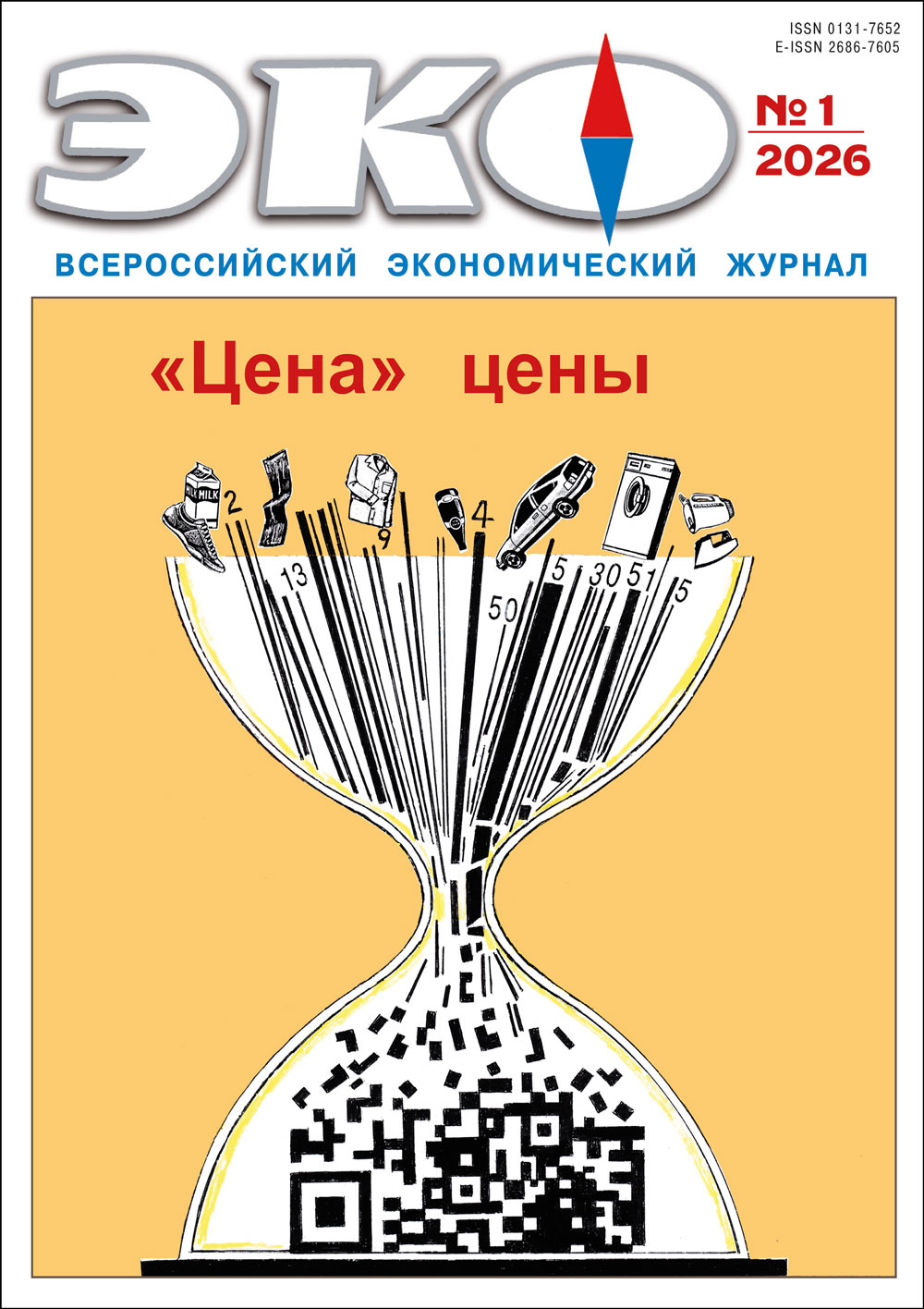
Тема номера: «Цена» цены
Ценовые взаимодействия в цифровой экономике: новые возможности и риски
Опубликован 29.01.2026
Ключевые слова
- нелинейное ценообразование; алгоритмическое ценообразование; ценовая политика; цифровые ценовые стратегии; потребитель; цифровая экономика
Как цитировать
1.
Розанова Н. Ценовые взаимодействия в цифровой экономике: новые возможности и риски. ECO [Интернет]. 29 январь 2026 г. [цитируется по 17 октябрь 2026 г.];56(1):27-40. доступно на: https://ecotrends.ru/index.php/eco/article/view/4934
Аннотация
В статье рассматриваются новые формы ценовых взаимодействий, получившие распространение в цифровой экономике. На основе анализа зарубежных эмпирических исследований выявляются ценовые инструменты, используемые современными компаниями. Показано, что цифровая экономика создает не только новые возможности для инновационных цифровых форматов (алгоритмическое нелинейное ценообразование, персонализированные цены, индивидуализированная ценовая динамика), но и порождает новые угрозы для компаний, связанные с ужесточением конкуренции и нелояльностью клиентов. Ценовое цифровое давление со стороны компаний порождает ответную сложную реакцию покупателей, изменяя ряд элементов оптимального потребительского выбора. Все это приводит к нелинейной зависимости между цифровой активностью фирмы и объемами продаж, доходами и прибылью.Библиографические ссылки
- Akyildirim, E., Corbet, S., Nicolau, J.L., Oxley, L (2025). Understanding reputational disaster during economic crises: evaluating aviation sector response differentials. Tourism Management. Vol. 106. No. 105028. DOI: 10.1016/j.tourman.2024.105028
- Apasrawirote, D., Yawised, K., Muneesawang, P. (2022). Digital marketing capability: the mystery of business capabilities. Marketing Intelligence and Planning. Vol. 40. No. 4. Pp. 477–496.
- Asker, J., Fershtman, C., Pakes, A. (2021). Artificial intelligence and pricing: the impact of algorithm design. NBER Working Paper No. 28535. Available at: http://www.nber.org/papers/w28535 (accessed 10.01.2024).
- Blut, M., Wunderlich, N.V., Brock, C. (2024). Facilitating retail customers’ use of AI-based virtual assistants: a meta-analysis. Journal of Retailing. Vol. 100. Pp. 293–315.
- Boik, A., Takahashi, H. (2020). Fighting bundles. American Economic Journal: Microeconomics. Vol. 12. No. 1. Pp. 156–187.
- Chang, D., Lee, J. (2022). Price skimming: commitment and delay in bargaining with outside option. Journal of Economic Theory. Vol. 205. No.1. DOI: 10.1016/j.jet.2022.105528
- Chen, S.J., Tamilmani, K., Tran, K.T., Waseem, D., Weerakkody, V. (2022). How privacy practices affect customer commitment in the sharing economy. Industrial Marketing Management. Vol. 107. Pp. 161–175.
- Cheng, Y., Zhang, K., Zhuang, X. (2024). Follow your heart or your mind: the effect of consumption frequency on consumers’ reliance on feelings. Journal of Business Research. Vol. 175. No. 114543. DOI: 10.1016/j.jbusres.2024.114543
- Conti, E., Camillo, F., Pencarelli, T. (2023). The impact of digitalization on marketing activities in manufacturing companies. The TQM Journal. Vol. 35. No. 9. Pp. 59–82.
- Ding, Y., Zhang, T. (2018). Price-directed consumer search. International Journal of Industrial Organization. Vol. 58. Pp. 106–135.
- Dowling, K., Manchanda, P., Spann, M. (2021). The existence and persistence of the pay-per-use bias in car sharing services. International Journal of Research in Marketing. Vol. 38. No. 2. Pp. 329–342.
- Endres, H., Auburger, J., Helm, R. (2024). Industrial innovation management in the age of digital transformation: the risk of too strong selling capabilities. Industrial Marketing Management. Vol. 117. Pp. 371–385.
- Fainmesser, I., Galeotti, A. (2020). Pricing network effects. American Economic Journal: Microeconomics. Vol. 12. No. 3. Pp. 1–32.
- Francke, A., Carrete, L. (2023). Consumer self-regulation: looking back to look forward. A systematic literature review. Journal of Business Research. Vol. 157. No. 113461. DOI: 10.1016/j.jbusres.2022.113461
- Garaus, M., Wagner, U., Rainer, R. (2021). Emotional targeting using digital signage systems and facial recognition at the point-of-sale. Journal of Business Research. Vol. 131. Pp. 747–762.
- Garcia, D., Shelegia, S. (2018). Consumer search with observational learning. RAND Journal of Economics. Vol. 49. No. 1. Pp. 224–253.
- Goel, P., Parayitam, S., Sharma, A., Rana, N., Dwivedi, Y. (2022). A moderated mediation model for e-impulse buying tendency, customer satisfaction and intention to continue e-shopping. Journal of Business Research. Vol. 142. No. 12041. DOI: 10.1016/j.jbusres.2021.12.041
- Halaburda, H., Jullien, B., Yehezkel, Y. (2020) Dynamic competition with network externalities: how history matters, The RAND Journal of Economics. Vol. 51. No. 1. Pp. 3–31.
- Honka, E., Seiler, S., Ursu, R. (2024). Consumer search: what can we learn from pre-purchase data? Journal of Retailing. Vol. 100. Pp. 114–129.
- Klein, T., (2021). Autonomous algorithmic collusion: q-learning under sequential pricing. The RAND Journal of Economics. Vol. 52. Pp. 538–558.
- Liu, J., Dalton, A.N. (2024). The inauthentic consumer: consequences of self-inauthenticity for possession disposal. Journal of Business Research. Vol. 181. No. 114741. DOI: 10.1016/j.jbusres.2024.114741
- Lotfi, A., Naoum-Sawaya, J., Lotfi, As., Jiang, Z. (2024). To skim or not to skim: studying the optimal pricing strategy for technology products. Omega. Vol. 127. No. 103079. DOI: 10. 1016.j. omega.2024.103079
- Moghddam, H.A., Carlson, J., Wyllie, J., Rahman, S.M. (2024). Scroll, stop, shop: decoding impulsive buying in social commerce. Journal of Business Research. Vol. 182. No. 114776. DOI: 10.1016/j.jbusres.2024.114776
- Nagel, Ch., Heidenreich, S., Schumann, J. (2024). Enhancing adoption of sustainable product innovations: addressing reduced performance with risk-reducing product modifications. Journal of Business Research. Vol. 179. No. 114684. DOI: 10.1016.j.jbusres.2024.11.4684
- Nanni, A., Ordanini, A. (2024). Digital signage for promoting price discounts: first insights into customer spending on distant and nearby discounted products. Journal of Retailing. Vol. 100. Pp. 186–198.
- Olsen, S., Khoi, N., Tuu, H. (2022). The well-being and ill-being of online impulsive and compulsive buying on life satisfaction: the role of self-esteem and harmony in life. Journal of Macromarketing. Vol. 42. No. 1. Pp. 128–145.
- Panniello, U., Natalicchio, A., Ardito, L., Petruzzelli, A.M. (2024). A cross-sector exploration of the barriers to customer satisfaction in the sharing economy. Journal of Business Research. Vol. 183. No. 114862. DOI: 10.1016/j.jbusres.2024.114862
- Rana, N.P., Kar, A.K., Gupta, M., Papas, I.O., Papadopoulos, T. (2023). Unravelling the dark side of sharing economy. Industrial Marketing Management. Vol. 113. Pp. A4-A10.
- Sairanen, M., Aarikka-Stenroos, L., Kaipainen, J. (2024). Customer-perceived value in the circular economy: a multidimensional framework. Industrial Marketing Management. Vol. 117. Pp. 321–343.
- Schuster, E., Spann, M. (2024). Pay today, or delay the pay: consumer preference for double flat-rate pricing plans. Journal of Business Research. Vol. 182. No. 114804. DOI: 10.1016.j.jbusres.2024.114804
- Shams, R., Chatterjee, S., Chudhuri, R. (2024). Developing brand identity and sales strategy in the digital era: moderating role of consumer belief in brand. Journal of Business Research. Vol. 179. No. 114689. DOI: 10.1016/j.jbusres.2024.114689
- Soderstrom, C., Mikalef, P., Landmark, A.D., Gupta, S. (2024). Augmented reality (AR) marketing and consumer responses: a study of cue-utilization and habituation. Journal of Business Research. Vol. 182. No. 114813. DOI: 10.1016/j.jbusres.2024.114813
- Strauss, I., O’Reilly, T., Mazzucato, M. (2023). Amazon’s algorithmic rents: the economics of information on Amazon. Institute for Innovation and Public Purpose. Working Paper 2023–12. Available at: https://www.ucl.ac.uk/bartlett/public-purpose/wp2023–12 (accessed 14.05.2024).
- Weber, N., Marchand, A., Kunz, R. (2024). Price and delay decisions for sequentially released products: the case of transactional streaming services. International Journal of Research in Marketing. Article in press. Available at: https://doi.org/10.1016/j.ijresmar.2024.04.003 (accessed 10.10.2024)
- Wieringa, J., Kannan, P., Ma, X., Reutterer, T., Risselada, H., Skiera, B. (2021). Data analytics in a privacy-concerned world. Journal of Business Research. Vol. 122. Pp. 915–925.
- Yuan, N., Feng, H., Li, M., Feng, N. (2022). Penetration or skimming? Pricing strategies for software platforms considering asymmetric cross-side network effects. Journal of the Association for Information Systems. Vol. 23. No. 4. Pp. 966–998.
- Zhang, J., Chiang, W. (2020). Durable goods pricing with reference price effects. Omega. Vol. 91. No. 9. Article 102018. DOI: 10.1016/j.omega.2018.12.007.
- Zhang, S., Chan, T.Y., Luo, X., Wang, X. (2022). Time-inconsistent preferences and strategic self-control in digital content consumption. Marketing Science. Vol. 41. No. 3. Pp. 616–636,
- Zielke, S., Komor, M. (2025). Why do customers choose online or offline channels? A framework of motives and its application in an international context. Journal of Retailing and Consumer Services. Vol. 82. No. 104054. DOI: 10.1016/j.jretconser.2024.104054